Wednesday, April 19, 2017

P is for Peace and Plenty


This month I'm participating in A to Z Challenge, where 100's of bloggers around the world challenge themselves to write every day for the month of April, working their way through the alphabet.  I'm sewing a patchwork block for each letter of the alphabet. Each day I will share that block and a little about the block and direct you to where you can find a tutorial for that block on the Web.


Once again the pattern for this block comes from Quilter's Cache and can be found here. It's centre is a pinwheel, one of my favourite block units. Its probably the kid in me. I always loved pinwheels! In a quilt block I love the sense of movement that a pinwheel can create. The whole block is made up of half square triangles - 16 of them in all. - 4 for the pinwheels and 12 for the flying geese units and side units. It would be possible to make the flying geese looking units as flying geese rather than 2 half square triangles but it would use more fabric. 


An internet search found lots of examples of the block in a variety of fabric


I wasn't able to find any examples of quilts made apart from diagram on Quilt Cache. I actually don't like it. Its very messy when put together in the quilt. I feel it is a block that looks great in sample quilt or sashed blocks but not so great on its own


Tuesday, April 18, 2017

O is for Ohio Star

This month I'm participating in A to Z Challenge, where 100's of bloggers around the world challenge themselves to write every day for the month of April, working their way through the alphabet.  I'm sewing a patchwork block for each letter of the alphabet. Each day I will share that block and a little about the block and direct you to where you can find a tutorial for that block on the Web.


My E block was the Eight Pointed Star and when blogging about it I discussed the fact that there are lots and lots of Star blocks. The most famous/common/popular/well known - call it what you will - is the Ohio Star. It is certainly one of the first blocks I learned about. 

Another traditional and very popular block the pattern for which can be found here on Quilter's Cache. 


There is a YouTube video of how to make the block here on Missouri Star Quilt Company. Its a great resource


The photo isn't showing the colours I used too well. Its actually 2 shades of green with a white centre with multicoloured dots on it.


The Quilt Cache had this setting for the quilt - the Ohio Star block set with snowball blocks.


These are some other examples of Ohio Star quilts that are but a few that I found on the web


Today is the 15th day of the challenge and O sees the completion of another row of my A to Z quilt. This is what we have so far


Monday, April 17, 2017

N is for Next Door Neighbour


This month I'm participating in A to Z Challenge, where 100's of bloggers around the world challenge themselves to write every day for the month of April, working their way through the alphabet.  I'm sewing a patchwork block for each letter of the alphabet. Each day I will share that block and a little about the block and direct you to where you can find a tutorial for that block on the Web.


The Next Door Neighbor block is a traditional  block from the time of the civil war. According to Barbara Brackman on the website Civil War Quilts it was named by the Ladies' Art Company of St Louis in the early 20th Century. I found a number of websites that had tutorials for making this block. 

Next Door Neighbour was chosen from Quilter's Cache. The pattern can be found here . I chose it because it would end up the right size.


A quilt made from the blocks has a secondary pattern which I find gorgeous. A quilt from this block alone would be wonderful... a sort of basket weave affect


Saturday, April 15, 2017

M is for Michigan

This month I'm participating in A to Z Challenge, where 100's of bloggers around the world challenge themselves to write every day for the month of April, working their way through the alphabet.  I'm sewing a patchwork block for each letter of the alphabet. Each day I will share that block and a little about the block and direct you to where you can find a tutorial for that block on the Web.


 Today block is Michigan, one of a number of blocks names after states in the USA.
This block identified on Quilter's Cache here as being a traditional block however I haven't been able to find it anywhere else on the internet.

I have found quite a number of other blocks with Michigan in their title which are all very different to this one.


Michigan is a variation of a string block. I love string blocks. They are so colourful and such a great way of using up scraps of fabric, long skinny ones that are too thin to be used in my regular piecing.

This one was paper pieced and so all the strings are the same width. In the past I have made them with various width string pieces. In my stash using system I class a string as any piece of fabric narrower than 1.5" and longer than... well probably 3" but usually 8".


My most recent string block quilt is one I called Stringen Em Along which was from a Bonnie Hunter pattern called String X. Instead of a paper block on which it was paper pieced I used a rectangle of fabric, some thin cotton from a worn out sheet. After I had sewn the strips on, the rectangles were cut to shape and then the side triangles sewn on to make the string part of it go diagonally. 


I have made it for our Japanese Grand daughter (the daughter of our host son Sho - the nearest thing I have to a grandchild). We are taking it with us to give to her when we see her in July.

This photo comes with a bonus picture of our dog Jack.

Like Michigan, each "block" consisted of 4 units (all the same) put together with great effect.

Michigan would make a very dramatic quilt too.


Friday, April 14, 2017

L is for Log Cabin


The Log cabin is a traditional block. Its one of the most well known blocks - and one of the oldest having been popular since the 1800s.

There are many variations on this block and this website has patterns for quite a few. 


Once again the pattern for this one came from Quilter's Cache. I used the basic pattern found
here

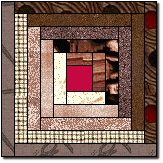
This is my block for the quilt. The red centre is often seen as traditional for this block but not longer really holds with modern quilters who use whatever floats their boat! I went traditional

There are so many different affects that can be made by how the blocks are arranged. These are just some of the arrangements which I found on this great website Piecemeal Quilts. It really is one of the most versatile blocks there is


This is a log cabin Christmas tree that I made for my famil a few years ago


Thursday, April 13, 2017

K is for Kings X


Kings Cross in Australia brings to mind the largest Red Light district in the country, situated in Sydney. Growing up it was considered very seedy and dangerous and not a place to visit at all. 


It was a place of brothels and street prostitution, strip clubs, drug dealers and runaways. 

Things have changed a bit over the years. Its become a bit more upmarket. (see this article from ABC News) Attitudes have altered somewhat and brothels are legal in some circumstances but.... it still has a bit of a reputation. 

I was really surprised to learn as I grew up that there was a Kings Cross in Britain and more surprisingly that it wasn't the centre of the prostitution in London. I do confess though that I still thought twice when booking accomodation in Britain when the recommended hostel was at Kings Cross! Harry Potter helped enlighten me somewhat and then it became a must see destination.


London 2010 I visited the famed station and found platform 93/4 with my two older children aka Fangirl and The Beast


ANYWAY

Kings Cross or in this case Kings X is also a traditional quilting block (and not a hint of redlight or trains about it - although it does resemble the sign for railway crossing)

As is to be found with traditional blocks there are a few variations on the block all called Kings Cross. 


The pattern for this block came from Quilter's Cache here 

I didn't have enough of the dark blue spot to make all the units so I substituted another fabric as close to the original as I could


When the blocks are put together into a quilt a secondary pattern emerges.